About TOSA OASISCON 2026
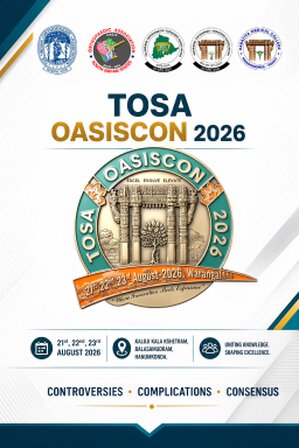
TOSA OASISCON 2026 proudly celebrates its Silver Jubilee edition, symbolising 25 years of academic distinction and orthopaedic excellence in South India. this landmark gathering reflects a proud legacy of excellence, collaboration, and continuous advancement in the field of orthopaedic medicine. Bringing together eminent orthopaedic surgeons, dynamic young consultants, postgraduate students, researchers, and allied healthcare professionals, the conference serves as a vibrant platform for exchanging knowledge, presenting breakthrough research, and discussing evolving surgical techniques. From trauma care to arthroplasty, sports injuries to emerging technologies, OASISCON continues to shape the standards of modern orthopaedic practice. Hosted in the historic heritage city of Warangal, the conference offers not only an enriching academic experience but also a setting that blends tradition with progress. Participants can expect thoughtfully curated scientific sessions, expert-led panel discussions, case-based deliberations, hands-on insights, and invaluable networking opportunities.
Organised in collaboration with the Telangana Orthopaedic Surgeons Association (TOSA), the Department of Orthopaedics, MGM, and the Warangal Orthopaedic Surgeons Association, this conference reflects a united commitment to advancing education, strengthening professional bonds, and empowering the next generation of orthopaedic leaders.
TOSA OASISCON 2025 is more than a conference — it is a celebration of knowledge, innovation, and the shared vision of elevating orthopaedic excellence across the region.
In collaboration with
Key Dates & Announcements
Who should attend: Orthopaedic surgeons, fellows, residents, physiotherapists, and industry partners.
- 3 days of cutting-edge orthopaedics: Aug 21–23, 2026
- Multi-track program: trauma, arthroplasty, arthroscopy, spine, Foot & Ankle , paediatrics
- Hands-on workshops and live demos
- 6 Credit Points accredited CME
- Expected attendance: 800+ delegates
Latest Announcements
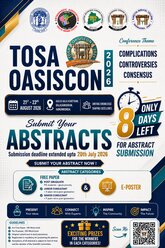

Key Dates & Announcements
Join peers from across India to discuss best practices, innovations, and real-world cases.
- Early-bird registration deadline: March 31, 2026
- Trade Broucher
- Abstract notification: April 15, 2026
- Workshop seat confirmations: Rolling, first-come-first-served
- Onsite registration opens: March 15, 2026, 8:00 AM
Latest news and updates will be posted here and on our TOSA OASIS-Blog.
Conference Highlights



Venue & Travel Snapshot
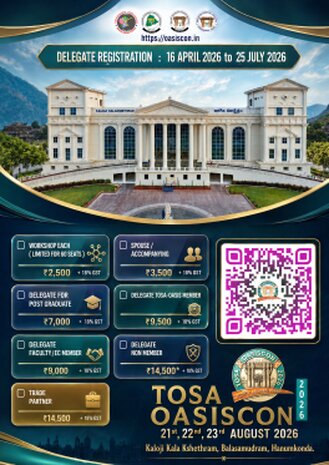
Venue: Kaloji KalaKshethram, Balasamudram, Hanamkonda
- Central location with ample parking
- Closest rail: Kazipet Jn (KZJ); Airport: Hyderabad (HYD)
- Local transit: cabs, autos, city buses
Plan your journey and stay with our comprehensive guide.
Explore Warangal
Warangal (వరంగల్), historically known as Orugallu, is a prominent city in the Indian state of Telangana and serves as the headquarters of the Warangal district. With a population of over 8 lakh people according to the 2011 Census, it is the second largest city in Telangana, spreading across approximately 406 square kilometers.
Warangal holds a significant place in South Indian history as the capital of the powerful Kakatiya dynasty, which was established in 1163 CE. The legacy of the Kakatiya rulers can still be seen throughout the city in the form of magnificent forts, temples, lakes, and iconic stone gateways. These historical monuments have made Warangal one of Telangana’s most admired heritage and tourist destinations. The famous Kakatiya Kala Thoranam, a grand stone arch symbolizing the architectural brilliance of the Kakatiya era, has even been adopted as part of the official emblem of the state of Telangana. Because of its rich traditions in art, architecture, and culture, Warangal is often referred to as the “Cultural Capital of Telangana.”
Recognizing its historical importance, the Government of India selected Warangal as one of the Heritage Cities under the HRIDAY (Heritage City Development and Augmentation Yojana) scheme, aimed at preserving and enhancing the infrastructure of culturally significant cities. The city has also been chosen under the Smart Cities Mission, enabling investments in modern urban development, improved infrastructure, and new industrial opportunities.
Warangal has gained international recognition as well. UNESCO has included the city in its Global Network of Learning Cities (GNLC), acknowledging its efforts to promote lifelong learning and educational development at the local level.
The urban region of Warangal actually consists of three closely connected cities—Kazipet, Hanamkonda, and Warangal—collectively known as the Warangal Tri-City. These cities are well connected through National Highway 163, linking them to Hyderabad and other major destinations. The region is also served by important railway hubs including Kazipet Junction and Warangal Railway Station, making it easily accessible from across the country.
Historical Legacy of Warangal
Warangal has a rich and fascinating history, once serving as the ancient capital of the powerful Kakatiya dynasty, one of the most influential kingdoms in South India. The dynasty was founded by Beta Raja I, who ruled for nearly three decades and laid the foundation for the Kakatiya empire. He was succeeded by his son Prola Raja I, who later shifted the capital to Hanamkonda, marking an important phase in the kingdom’s expansion.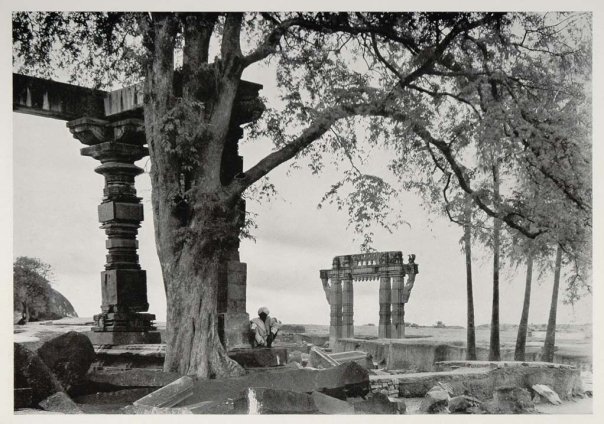
Over time, several prominent rulers strengthened and expanded the Kakatiya kingdom, including Beta Raja II, Prola Raja II, Rudradeva, Mahadeva, Ganapathideva, Prataparudra, and the legendary Rani Rudrama Devi. Rani Rudrama Devi holds a special place in history as one of the very few women to rule the Telugu region, known for her courage, administrative skill, and progressive governance.
During the reign of King Ganapathideva, the capital was officially shifted from Hanamkonda to Warangal, which soon developed into a thriving center of governance, culture, and architecture. Historical inscriptions from the Kakatiya era praise Warangal as one of the greatest cities of the Telugu region, extending its influence up to the coastal shores.
The Kakatiya rulers left behind an extraordinary architectural legacy that continues to attract historians and visitors today. Their contributions include the majestic Warangal Fort, the iconic four massive stone gateways (Kakatiya Kala Thoranams), the Swayambhu Temple dedicated to Lord Shiva, and the magnificent Ramappa Temple located near the scenic Ramappa Lake. The prosperity and administrative brilliance of the Kakatiya kingdom were even noted by the famous traveler Marco Polo, who documented the region’s cultural richness.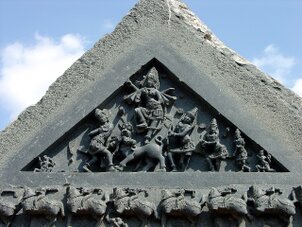
Following the fall of King Prataparudra II, Warangal came under the control of the Delhi Sultanate. Soon after, the Musunuri Nayaks, led by regional chieftains, united 72 Nayak leaders and successfully reclaimed Warangal, ruling the region for nearly fifty years. After their decline, the region became part of the Bahmani Sultanate, and later the Golconda Sultanate.
In 1687, the Mughal emperor Aurangzeb conquered Golconda, bringing Warangal under the rule of the Mughal Empire. The region remained under Mughal control until 1724, when the southern provinces separated to form the Hyderabad State, which included Telangana and parts of present-day Maharashtra and Karnataka.
After India gained independence, the Hyderabad State was integrated into the Indian Union in 1948. Later, in 1956, the States Reorganisation Act merged the Telugu-speaking Telangana region, including Warangal, with Andhra Pradesh. Following decades of regional movement and aspirations for separate statehood, the state of Telangana was officially formed on 2 June 2014, and Warangal proudly became one of its most historically significant cities.
Our Sponsors





Stay Connected
Never miss an update. Subscribe for program releases, deadlines, and travel tips.
Quick contact : telanganaorthopaedic@gmail.com
Mobile Number : +91-9246899108
Or reach us via the Contact page for queries and support.